
Written by Dr Teresa Dirsuweit
In 2024, WaterCAN — an organisation that monitors and reports on water quality — distributed testing kits to volunteers across the Johannesburg area. Dedicated citizen scientists have been regularly testing the city’s streams and monitoring pollution sources. The results have been grim. Many of the tests have shown unacceptably high levels of E. coli and coliforms in Johannesburg’s rivers, with numerous testers reporting sewage overflows that appear to flow directly into the waterways.
The water in the Montgomery Spruit has been tested over several months for WaterCAN. Results consistently show high levels of E. coli and coliforms, confirming that the river is heavily polluted. Dissolved pieces of toilet paper can be observed throughout the stream. Residents living near the river have raised concerns that the toad population has declined, suspecting that this may be linked to the pollution. Conservationist zoologists were called in and confirmed that, because toads are an indicator species sensitive to pollution, they are unlikely to be found in areas with high levels of faecal contamination.
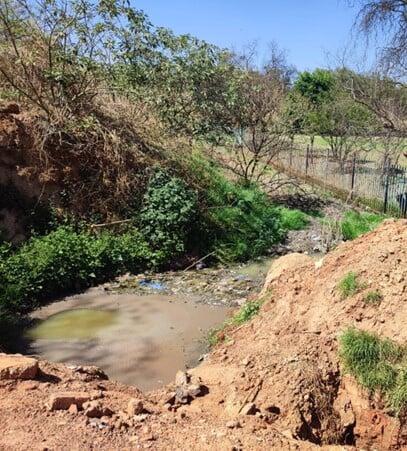
Residents and conservationists, together with Dr Teresa Dirsuweit of the UNISA Geography Department, traced what they believe to be the source of the sewage to the decommissioned Waterval dump site. There, streams of raw sewage run down the slopes of the dump, flow onto Stonewall Road, and into the adjacent Esperanza Primary School. Large pools of sewage have formed beside the school’s playing fields, emitting a shocking stench. Toilet paper and used sanitary products have been observed on the playground. This situation has persisted since May 2025. Numerous complaints have been submitted to Johannesburg Water, which has indicated that while temporary repairs are possible (and have now begun), the problem is complex and requires equipment that has not yet been procured. Communication from Johannesburg Water, however, has been limited, adding to the frustration of school staff and nearby residents.
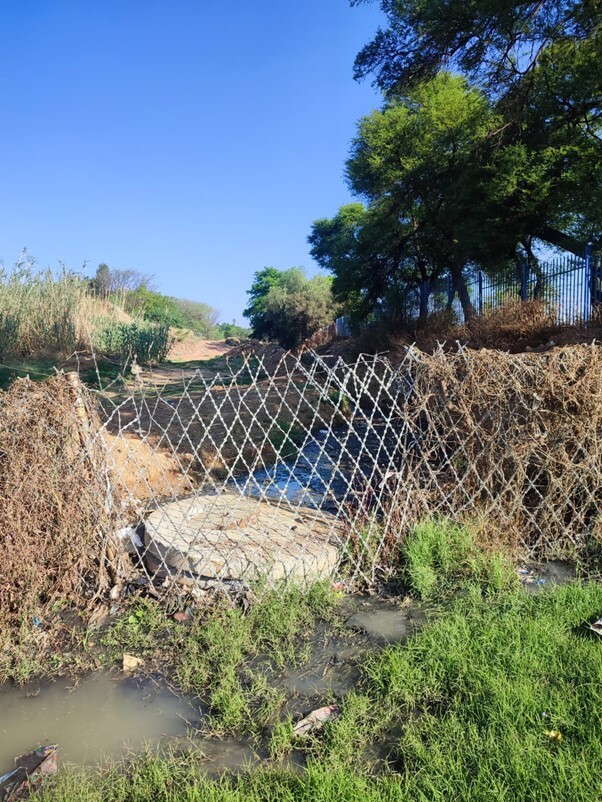
The sewage problem at the old Waterval dump site is not the only issue of concern. Residents in and around the Albertsville area have reported frequent sewer blockages, while citizen scientists have documented overflowing manholes discharging effluent into the Westdene Spruit, which flows through the Johannesburg Botanical Gardens in Emmarentia. The Pampoen Spruit in Randburg is also severely polluted, with toilet paper visible in the water, turning it a murky grey and releasing a strong odour. High levels of E. coli and coliforms have been confirmed. The pollution originates from multiple leaking sewers feeding directly into the river.
The Bill of Rights guarantees South Africans “an environment that is not harmful to their health or wellbeing” and the right to have that environment “protected, for the benefit of present and future generations, through reasonable legislative and other measures that… prevent pollution and ecological degradation.”
Johannesburg is one of the few major cities in the world without a major river flowing through it. The watershed — dividing the flow toward the Limpopo River in the north and the Orange River in the south — lies on the city’s western edge. The streams and wetlands of Johannesburg are vital ecological systems for urban wildlife. They are also important spaces for recreation, reflection, and cultural and religious practices. These environments are, however, becoming increasingly fragile.
As residents of Johannesburg, there are several actions we can take:
Report sewage leaks to Johannesburg Water and keep the reference number issued.
Follow up on reported issues and engage with Johannesburg Water.
If the issue is not resolved, contact organisations such as WaterCAN, Jozi Riverwatch, and your local councillor.
Join local river clean-up initiatives to help rehabilitate our waterways.
Work with residents’ associations or environmental groups to apply pressure for accountability and action.
