
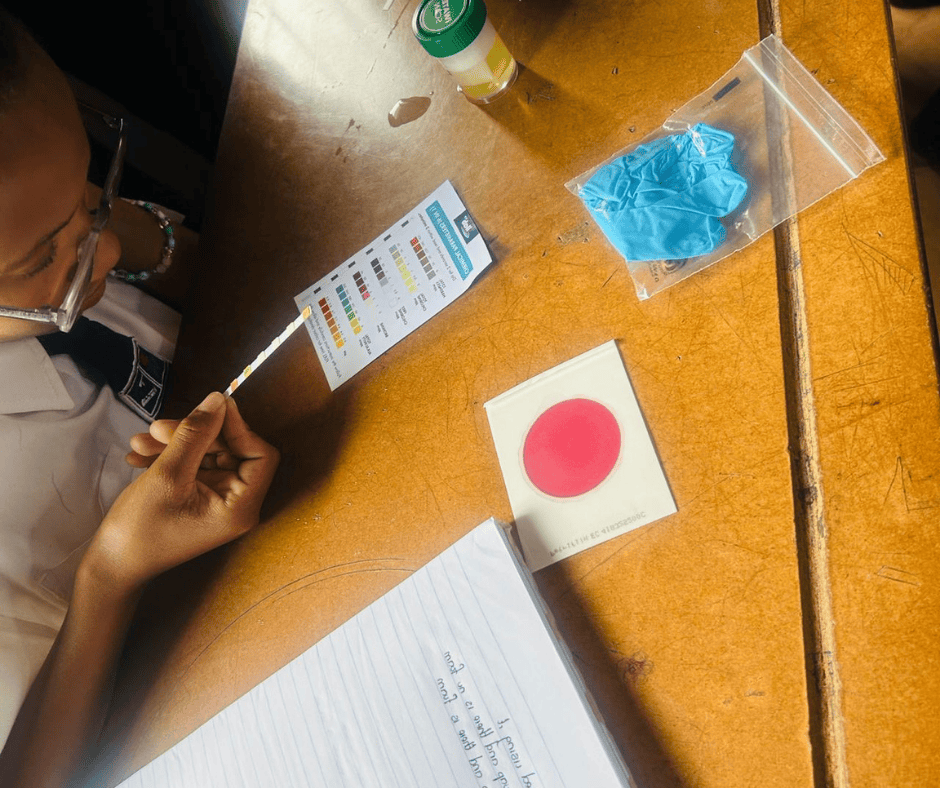
Results from the WaterCAN Schools Water Testing Project have revealed alarming findings, with nearly a third of participating schools recording high levels of E-coli in their drinking water.
Of the 72 schools that submitted their drinking water test results to WaterCAN, 20 test results have been flagged as dangerously unsafe.
Even more concerning was that of the 20 unsafe samples, 12 were directly from taps. The remaining eight were from water tanks.
The school testing results further confirms WaterCAN’s concerns about South Africa’s deepening water and waste water crisis and amplifies findings of the Green Drop Report as well as the Blue and No Drop progress reports released last month by the Department of Water and Sanitation.
WaterCAN has issued urgent letters to the affected schools and relevant local authorities, calling for immediate intervention.
WaterCAN’s Citizen Science and Training Coordinator, Nomsa Daele, said the results were “highly concerning” because they indicate possible faecal contamination and pose a direct health risk to learners and staff and further deepen WaterCAN’s concern that South Africa’s water crisis is in critical state following years of decline.
“The presence of E. coli in drinking water is particularly serious and requires urgent attention, as it may lead to waterborne illnesses. Ensuring safe drinking water in schools is critical to protecting the health, dignity, and wellbeing of children. Although these are indicator tests, they serve as an important early warning of contamination. We have advised the schools to exercise caution and avoid using the water for drinking purposes until the matter is resolved,” said Daele.
Daele said WaterCAN's schools-based citizen science-driven initiative is especially pertinant given Earth Day being celebrated on 22 April 2026.
“The 2026 Earth Day theme, ‘Our Power, Our Planet,’ underscores that environmental progress depends on community action, innovation and local solutions, not only national policy. It highlights the need to strengthen energy reliability, advance sustainability and inspire collective action by citizens, schools and cities to protect the planet.”
Daele said WaterCAN had asked municipalities responsible for supplying water to the affected schools to:
- conduct confirmatory water quality testing at the schools;
- investigate the source of the contamination; and
- take immediate corrective action to ensure the water is safe for consumption.
- conduct confirmatory water quality testing at the schools;
- investigate the source of the contamination; and
- take immediate corrective action to ensure the water is safe for consumption.
“Given the potential risk to children’s health, we urgently need a prompt response and action on this matter,” said Daele.
The municipalities contacted were:
- Chief Albert Luthuli Local Municipality, Mpumalanga;
- Winnie Madikizela-Mandela Municipality, Eastern Cape;
- City of Cape Town, Western Cape
- Enoch Mgijima Local Municipality, Eastern Cape;
- Makana Municipality, Eastern Cape;
- Matjhabeng Local Municipality, Free State;
- Mpofana Local Municipality, KZN;
- Nelson Mandela Bay Metropolitan; Eastern Cape
- Nketoana Local Municipality, Free State;
- Sundays River Valley Local Municipality, Eastern Cape;
- Umvoti Local Municipality, KZN.
“Of deep concern is that in some of municipalities where biological elements were found in school drinking water were also flagged for failing to meet basic compliance requirements in the Blue Drop Report released in 2023,” said Daele.
Daele said the municipalities found in the 2023 Blue Drop Report to have not met the basic requirements of SANS 241:2015 drinking water standards included Makana, Chief Albert Luthuli, Sundays River and Nketoana.
Using WaterCAN’s Citizen Science Testing Kit, participating schools have been testing their water and uploading the results to WaterCAN’s MapMyWater Portal. Sponsored by the French Embassy in South Africa, the portal is a flagship WaterCAN initiative that provides real-time analysis of uploaded results while making them publicly accessible, helping to build one of South Africa’s largest independent, citizen-generated water quality datasets.
Daele said 2026 marks a near doubling in the number of participating schools compared with the previous year, and that reaching all nine provinces is a sign of how important the schools project has become.
WaterCAN’s partners are Adopt-a-River, Enviro Vito, the Ahmed Kathrada Foundation, Rhodes University, the Nelson Mandela Bay Science Centre, the Wildlife and Environment Society of South Africa, the Cape Town Science Centre, the Institute for Water Research and the LEAP Institute.
The WaterCAN Schools Water Testing Project ran from 16-27 March with many schools still testing into April.
Attention Media: Please find images you can use here.
Attention Media: You can find a selection of images that you can use here that were taken by participating schools.
Donate to WaterCAN
Across South Africa, WaterCAN’s volunteers and citizen scientists are monitoring drinking water and sanitation failures, uncovering risks, and demanding action from those responsible. We challenge polluters, call out government negligence, and stand with communities whose rights to safe water and sanitation are routinely violated. Your support keeps this watchdog work alive and powerful.
For Media Enquiries please contact WaterCAN Communications Manager on Jonathan Erasmus 073 227 6075 or email media@watercan.org.za.
