
The South African Human Rights Commission (SAHRC) is actively hosting hearings for its investigative inquiry into the Gauteng water crisis. The public inquiry officially runs from May 19 to 21, 2026, to investigate systemic infrastructure failures, intermittent supplies, and their impact on vulnerable communities across the province.
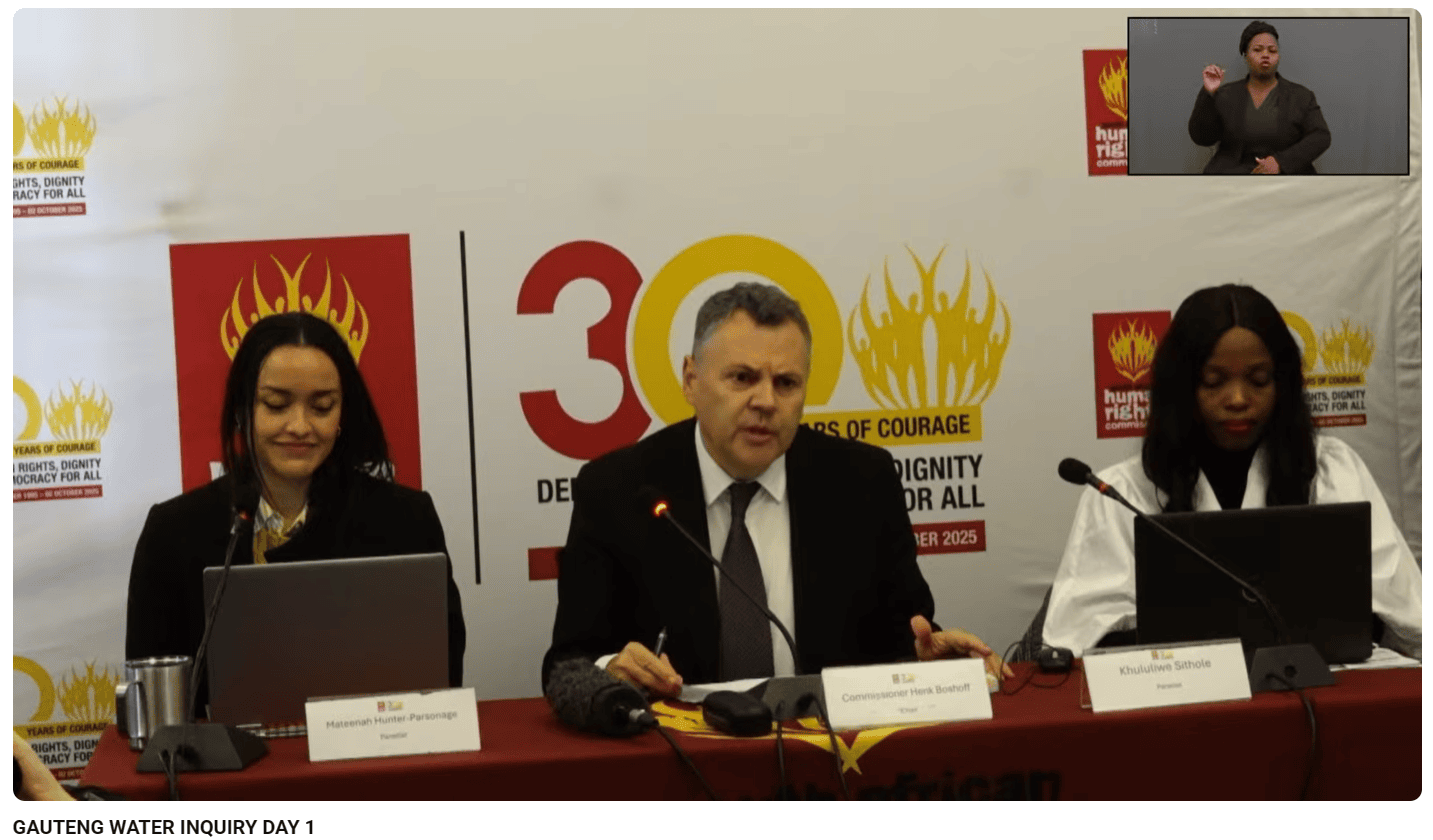
Below is our oral submission to the South African Human Rights Commission delivered in person.
Date: Tuesday, 19 May 2026
Venue: Human Rights Conference Room at the Old Fort Prison, Constitution Hill, 1 Kotze Street, Braamfontein
READ: Our full submission can be found here.
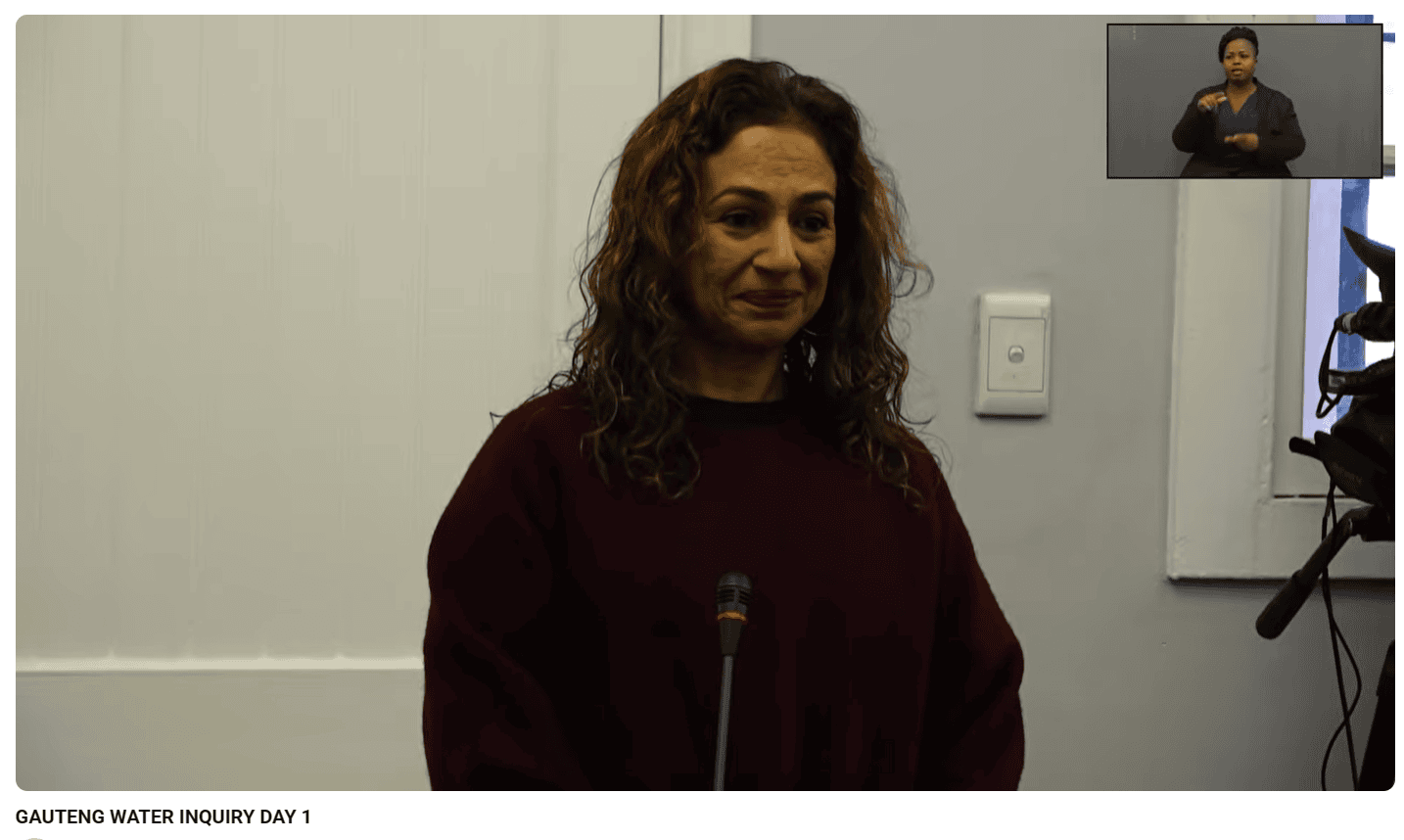
WATCH: Dr Ferrial Adam's reads her submission into the record here.
Good morning Chairperson, Commissioners and members of the public.
The Gauteng water crisis is not simply a story about drought, bulk supply constraints, or too little water in the system.
It is a systemic human rights crisis that is fed by governance failure, infrastructure neglect, poor to no financial controls, corruption and very weak transparency.
It is the result of failures by multiple organs of state to maintain, fund, monitor and govern the water services system in a way that ensures reliable access to sufficient, safe, acceptable and affordable water. [The taps did not run dry overnight. This crisis was budgeted for, ignored and allowed to deepen]
While all levels of government has got us here, the way that this crisis is now manifesting is as a crisis at local government failure.
In Gauteng, inequality is now visible in water pressure, tanker access and who can afford backup systems.
This submission focuses mainly on the City of Johannesburg and its wholly owned entity, Johannesburg Water. That focus is due to time and resource constraints. But WaterCAN urges the Commission to apply similar scrutiny to other Gauteng municipalities.
- In Ekurhuleni = R39 million on a sewer pipe project.
- In Emfuleni = R24 million spent on 30 toilets = R800K per toilet
- Tshwane = Hamaanskraal continues.
Our submission deals with several areas of concern. In the time available, I will focus on the key themes.
These include failures in how equitable share funding is used to support free basic services; the city’s decision to provide six kilolitres of free water to every formal household, regardless of income, while informal settlements remain underserved; the use of sweeping accounts that allow water revenue to be held and potentially used elsewhere in the city; the rise of water mafias and weak procurement and governance controls; and the lack of an intergovernmental response and how such institutions can be held accountable.
The failure to maintain and renew infrastructure is a rights issue. A municipality cannot rely indefinitely on emergency measures while known infrastructure risks continue to accumulate.
The rights violation lies not only in the absence of water from taps. It also lies in the state’s repeated failure to prevent, disclose, plan, fund and remedy known risks to access to water (and sanitation).
WaterCAN supports the Commission’s inquiry. But we caution that this must not become another inquiry that goes nowhere. Gauteng has already seen task teams, committees, “bomb squads” and even presidential interventions. Residents are still waiting for reliable water. [The constitutional right to water cannot survive on press statements and task teams.]
We ask the Commission to provide clear direction, with monitored actions, specific responsibilities and firm timelines, and to use the powers at your disposal to demand action.
This crisis cannot continue.
WaterCAN accepts that bulk supply constraints matter. We also accept that Rand Water has a role. But the central failure is in the municipal delivery system: the infrastructure that carries treated water from bulk supply to residents. [although I want to say that RW cannot think they operate in a vacuum – their actions affect the municipalities in a weak system]
Infrastructure is deteriorating.
Reservoirs, towers, pump stations and pipelines are damaged, collapsing, vandalised or inadequate. On the sanitation side, sewers overflow, pump stations fail, and wastewater treatment works are damaged or poorly maintained.
The Blue Drop, No Drop and Green Drop reports show that Gauteng’s drinking water treatment systems are not necessarily the worst in the country. But that does not mean household water access is secure.
Emfuleni – has a NRW score of 70,8%
On paper, Gauteng municipalities, such as Johannesburg, should be able to address much of the sanitation infrastructure collapse.
But, like in Johannesburg, available capital is often not effectively spent. Projects are poorly managed, municipalities lack capacity, tenders are manipulated, and corruption undermines delivery.
In Johannesburg, the crisis is uneven. Some areas experience repeated dry taps, low pressure, water “load shedding”, tanker dependence and real hardship. Informal settlements often face permanent inadequate access to water. Other areas experience inconvenience rather than deprivation. [Non-payment of contractors impact the vulnerable first]
This raises serious equality concerns.
The heart of our submission is the financial relationship between the City of Johannesburg and Johannesburg Water.
We argue that Johannesburg Water’s financial position is compromised and will continue to be compromised until city level financial decisions are made to ensure that delivery of services to people. We cannot have a city that increases the number of board members from 86 (2022/23) to 385 (2026/27), where levies are surreptitiously increased and added to people’s bills. Where a budget speaks of other losses (R13,68 billion) but we are not sure what this means?
Residents pay for water, but it is not clear that money collected for water is protected and spent on water related needs. The lack of will to ensure that the budget for water and sanitation is ringfenced with urgency is concerning. To us it feels as if the can is being kicked down the road.
While funding is clearly tight, especially given the collapse of existing infrastructure and the need to build new capacity, there are strong indications that funds are being badly managed while corrupt networks continue to thrive. [not only in jhb but all across – we need to stop the leaking bucket of money]
That is the core concern.
One of the first issues is free basic services.
Municipalities receive equitable share funding from National Treasury to support free basic services for indigent households. But the City of Johannesburg appears to move this money into general municipal funding without proper ringfencing.
It is therefore unclear whether Johannesburg Water receives the correct subsidy for the free basic water and sanitation it provides.
The estimated cost of providing free basic water to all formal households is about R498 million a year. By comparison, the city’s stated cost of providing all free services to informal settlements is recorded at less than R1 million a year. That appears unrealistic and unfair.
Surcharges are another serious concern.
Johannesburg Water charges surcharges on certain water tariffs, but its budget does not show surcharge revenue going back to Johannesburg Water.
[Residents are paying for water twice - once through their tariffs, and again through dry taps, tankers and lost dignity.]
That raises a simple question: if residents are paying water related surcharges, where does that money go?
At a time when Johannesburg Water is under severe strain, surcharge revenue should help maintain infrastructure, reduce losses and improve service delivery. If it is diverted elsewhere, it weakens the very system residents are paying to support.
We ask the Commission to interrogate this.
There are also questions about money flowing from Johannesburg Water back to the city.
Johannesburg Water pays hundreds of millions of rand each year in intercompany operational costs and records intercompany interest. These costs need clearer explanation.
Then there is the sweeping account.
Johannesburg Water’s own annual report says all its cash is swept daily to the City of Johannesburg. By the end of June 2024, R2.811 billion of Johannesburg Water money was recorded in the city’s sweeping account. Johannesburg Water’s total loans to the city shareholder that year were R4.144 billion.
This is alarming because the money is treated as a loan to the shareholder with no fixed repayment terms.
In plain language, the city can hold Johannesburg Water’s money, and it is not clear when, or whether, that money will return to the water entity.
That is why WaterCAN asks: WHERE IS THIS MONEY?
Debt impairment is another major concern.
Johannesburg Water and the City of Johannesburg have a serious problem with uncollected revenue. The predicted figures for debt impairment continue to rise, from R5.130 billion in 2025/26 to R6.012 billion in 2027/28.
If this debt impairment is treated as an annual expense, it is included when calculating the revenue needed to run the service, and therefore affects the tariffs charged to paying customers.
It is unreasonable to expect customers to carry this cost indefinitely.
There should be a cap on the level of debt impairment that Johannesburg Water is allowed to load onto tariffs.
The submission also deals with vandalism. This applies to all of Gauteng.
The city often refers to vandalism as a major problem. We do not deny that vandalism exists. But its cost is not properly quantified, and there does not appear to be a clear strategy to address it.
Importantly, not all vandalism should be understood only as mindless destruction. Some incidents may be desperate attempts to access water. If people are breaking into infrastructure because they have no reliable water supply, the response cannot simply be policing. The city must also address the underlying failure to provide basic services.
We ask the Commission to require the City of Johannesburg and Johannesburg Water to account for the scale, causes and costs of vandalism, and to address the root causes.
The most important financial reform we propose is ringfencing.
Water and sanitation revenue must be protected and used for water and sanitation.
Johannesburg Water records annual surpluses, and its annual reports show an accumulated surplus. If annual surpluses are added from 2023/24 to the present, the accumulated figure could reach R18.138 billion.
Again, we ask: where is this money?
This issue is urgent because the long-promised ringfencing of water and sanitation budgets keeps being delayed. Residents and stakeholders were told these budgets would be ringfenced by June this year, but there are already indications that this may be postponed to 2027.
Ringfencing is not an administrative technicality. It is essential to restoring the water system and protecting residents’ rights.
The submission also looks at national grants and infrastructure funding.
National Treasury has changed infrastructure grant incentives to encourage better governance in metro trading services such as water, sanitation, electricity and refuse removal.
This is a good strategy. But we question whether the money is actually reaching Johannesburg Water.
Our submission points to discrepancies between National Treasury’s records of infrastructure related grants and the city’s own records. It also shows that increased grant funding does not appear to translate into increased Johannesburg Water capital expenditure.
Johannesburg Water’s capital spending is effectively flatlining, despite the scale of infrastructure failure.
We want infrastructure grants and international loans to be clearly linked to specific projects, with public information on what the funds are spent on and why those projects were prioritised.
Emergency responses are another major theme.
Water tankers, JoJo tanks and bottled water may be necessary during emergencies. But they are not a substitute for reliable piped water. A tanker is not a water strategy. It is evidence that the system has already failed.
They are often unreliable, poorly communicated, inaccessible, vulnerable to corruption, and inadequate for household and sanitation needs.
Our submission is particularly concerned about procurement.
The lack of transparency around procurement, despite financial laws requiring openness, enables corruption. For example, when Johannesburg Water ran a tender in January 2024 for potable water storage tanks on an as and when required basis for three years, it published a list of 39 bidders but did not publish their bid offers, saying it was “not practical to publish”. The list of bidders was published, but the final award was not.
If tanker systems become permanent, corrupt networks become entrenched, and the incentive to repair permanent infrastructure weakens.
WaterCAN argues that Gauteng’s water crisis involves several institutions, including municipalities, Rand Water, provincial and national government departments, and National Treasury – and civil society.
Municipalities are responsible for delivery, while other institutions provide funding, resources and oversight. But residents experience the failure as one crisis.
The Commission should not allow institutions to shift blame.
Instead, it should recommend a single public remedial plan with clear responsibilities, deadlines, funding sources and reporting duties.
WaterCAN asks the Commission to find that Gauteng’s water crisis is a systemic human rights concern requiring monitored, enforceable and time bound remedial action, with regular public reporting on progress.
We ask the Commission to require municipalities to prioritise water and sanitation as essential services, and to compel the City of Johannesburg to provide full records of allocated budgets and audited spending on water and sanitation projects over the past 10 years.
We further call for the ringfencing of water and sanitation revenue, the return of accumulated surpluses to water entities, greater transparency in procurement, and a national discussion on revenue collection and infrastructure vandalism.
We also call for all municipal water quality results to be made publicly available, for water tankers and static tanks to be managed more transparently with GPS and volume tracking, and for long term water supply solutions to be developed for informal settlements so that reliance on JoJo tanks and tanker deliveries is reduced and ultimately ended.
In closing, WaterCAN’s submission is not only about taps running dry.
It is about money, governance, rights and accountability. [and its about risk management]
The crisis was foreseeable. It has been worsened by poor planning, weak financial controls, infrastructure neglect, secrecy and corruption. And it is going to be exacerbated by climate change.
The crisis is not only the absence of water from taps. It is the repeated failure of the state to prevent known risks, disclose information, fund infrastructure, protect water revenue, and fix the systems that residents rely on. [The cost of inaction will not be measured only in money, but in public health, inequality and social instability]
The Commission is therefore asked not to produce another report that disappears.
It is asked to give clear direction, with monitored actions and firm timelines.
Because for residents, this is not an abstract governance problem.
It is a daily struggle for dignity, health, safety and survival.
And it cannot continue.
Donate to WaterCAN
Across South Africa, WaterCAN’s volunteers and citizen scientists are monitoring drinking water and sanitation failures, uncovering risks, and demanding action from those responsible. We challenge polluters, call out government negligence, and stand with communities whose rights to safe water and sanitation are routinely violated. Your support keeps this watchdog work alive and powerful.
For Media Enquiries please contact WaterCAN Communications Manager on Jonathan Erasmus 068 923 6600 or email media@watercan.org.za
