
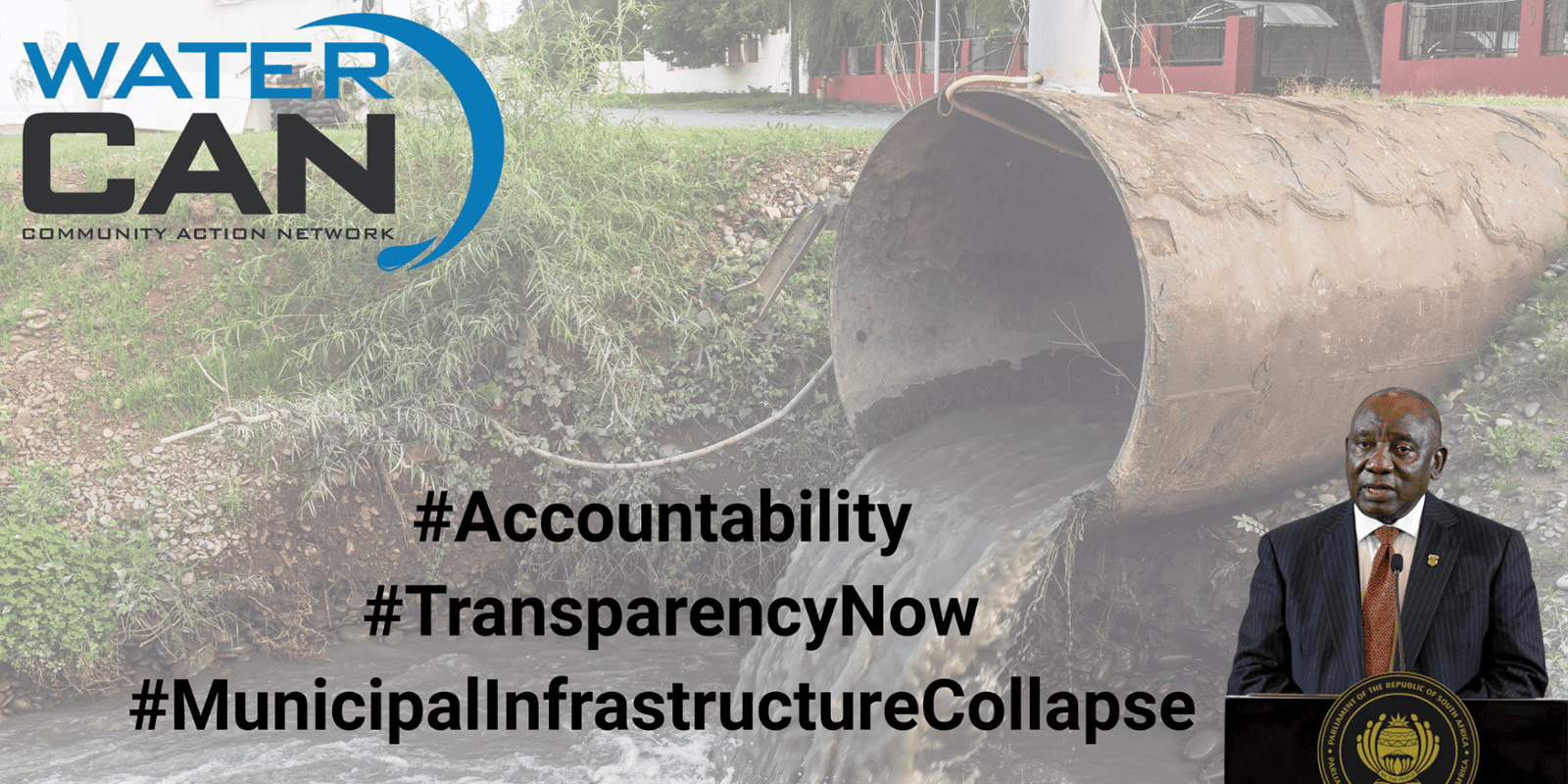
The Presidency’s National Water Action Plan comes at a time when communities across South Africa are living with prolonged outages, declining water quality, failing infrastructure and weak municipal accountability.
While the plan acknowledges the scale of the crisis, WaterCAN says its credibility will depend entirely on whether it produces action rather than adding another layer to an already complex system.
At the centre of the plan is the National Water Crisis Committee, known as Watercom. Chaired by the President, Watercom is intended to coordinate the response across national departments, provinces, municipalities and other water institutions, while monitoring implementation of the Action Plan.

WaterCAN says stronger coordination may be necessary, but South Africa has seen numerous strategies, committees and turnaround plans before. The creation of Watercom will only be meaningful if it has the authority and political will to enforce deadlines, demand transparent reporting and hold institutions accountable for repeated failures.
“We have seen many plans, committees and commissions that identify the right problems but fail to change what communities experience,” says WaterCAN Executive Director Ferrial Adam. “Watercom cannot become another structure that meets, reports and makes recommendations while taps remain dry and infrastructure continues to deteriorate.”
Many of the measures contained in the Action Plan are also not new. Proposals to ring-fence municipal water revenue, reduce water losses, repair ageing infrastructure, improve billing, strengthen technical capacity, reform institutions and attract additional investment have appeared in government policy and planning documents for years. Some have been under discussion, or possible under existing legislation, for well over a decade.
"This is not primarily a shortage-of-ideas crisis," Adam says. "Many of the solutions have been on the table for a very long time. The real problem has been weak implementation, fragmented responsibility and an absence of meaningful consequences when institutions fail. Tackling corruption is essential, but so is rebuilding capable municipalities that can deliver on their constitutional mandate. Private-sector investment can support the sector, but it cannot replace competent and accountable public institutions."
WaterCAN says Watercom must publish clear targets and implementation timelines, identify which institutions and officials are responsible for each intervention, and report publicly on progress. Communities should be able to see what has been promised, what has been delivered and what action is taken when deadlines are missed.
The organisation cautiously welcomes the increased national focus on the water crisis and the recognition that urgent intervention and significant investment are required. However, it says this must be matched by a clear role for civil society and affected communities in monitoring delivery.
“We need capable public institutions, a responsible private sector and an empowered civil society,” says Adam. “Communities and civil society organisations have spent years documenting water failures, testing water quality and raising the alarm. They should not be treated simply as stakeholders to be consulted after decisions have been made.”
WaterCAN supports responsible private-sector involvement where it can contribute finance, technical expertise and innovation to strengthen public water infrastructure. However, private participation must not become a mechanism for the privatisation of water services or allow the state to abdicate its constitutional responsibility to provide equitable, reliable and affordable water services for all. “We are not opposed to private capital or expertise,” Adam says. “But water services must remain publicly accountable, properly regulated and governed in the public interest. Access to water cannot be determined by the ability to pay.”
WaterCAN says the success of Watercom must ultimately be judged by practical outcomes: fewer outages, safer drinking water, repaired infrastructure, reduced water losses and institutions that are held accountable.
“South Africa does not need another structure that repackages old commitments,” Adam concludes. “It needs a mechanism that can finally turn those commitments into visible, measurable improvements in people’s lives.”
Donate to WaterCAN
Across South Africa, WaterCAN’s volunteers and citizen scientists are monitoring drinking water and sanitation failures, uncovering risks, and demanding action from those responsible. We challenge polluters, call out government negligence, and stand with communities whose rights to safe water and sanitation are routinely violated. Your support keeps this watchdog work alive and powerful.
For Media Enquiries please contact WaterCAN Communications Manager on Jonathan Erasmus 073 227 6075 or email media@watercan.org.za
