
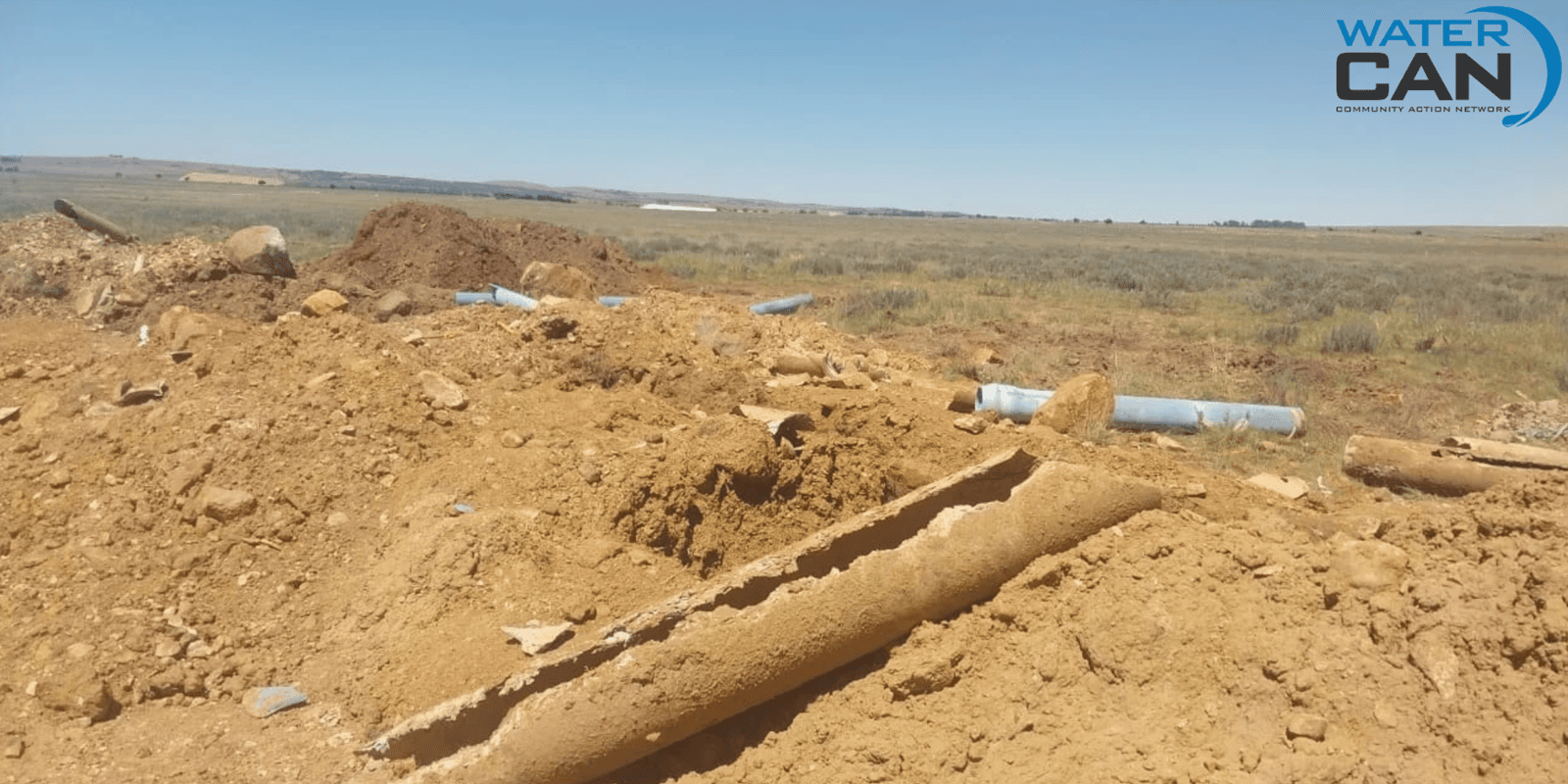
Editors Note: This letter is addressed to Lesedi Local Municipality, Rand Water and the National Water Crisis Committee, known as Watercom.
Lesedi Local Municipality is a local municipality within the Sedibeng District Municipality in Gauteng. Rand Water is a state-owned bulk water utility supplying municipalities across Gauteng and parts of neighbouring provinces. Watercom is the National Water Crisis Committee, chaired by the President and established to coordinate government’s response to South Africa’s water crisis.
Dear Lesedi Local Municipality, Rand Water and Watercom,
WaterCAN calls on all three institutions to urgently explain why communities across Lesedi continue to experience unreliable water supply and whether any restrictions on the municipality’s bulk-water allocation remain in place.
While residents have faced a deterioration in service for several years, the crisis has escalated in 2026 and requires urgent intervention.
There is a critical lack of public information about whether Rand Water has again reduced Lesedi’s bulk potable water supply, whether the municipality is meeting its debt repayment commitments, and what is causing the continuing pressure on the municipal water system.
Earlier this month WaterCAN received reports that more than 800 homes in Rensburg were without water for several days. But Rensburg was not experiencing these problems in isolation.
Municipal notices have reflected recurring water and electricity disruptions affecting communities including Emmasdal, Luckhoff and Heidelberg extensions 23 and 26, Obed Nkosi.
These repeated failures affect communities differently. Households without water-storage capacity, transport or the means to purchase alternative water have far fewer options when municipal supply fails for several days.
Residents across Lesedi are being forced to manage repeated outages without sufficient information to determine whether these failures are caused by reduced bulk supply, failures within Lesedi’s own infrastructure, electricity interruptions, or a combination of these factors.
In June, Rand Water restricted Lesedi’s bulk-water supply by 20% after the municipality failed to honour its debt repayment commitments. The impact was felt across the municipality, including in Ratanda and Obed Nkosi, where residents endured prolonged shortages and, in some cases, had to travel considerable distances to collect water. Following government intervention in July, the restriction was suspended.
Yet the supply problems have continued.
In September, Lesedi reported critically low reservoir levels and requested additional bulk supply from Rand Water. A high-level meeting between Rand Water and Lesedi on 4 September 2026 resulted in an intervention intended to stabilise supply.
However, the details of that intervention have not been made public.
Residents have not been provided with the agreement, action plan, implementation deadlines or a clear progress report showing what each institution committed to and what has subsequently been achieved.
Now Lesedi is again reporting critically low reservoir levels following a drop in water intake pressure.
On 12 October 2026, Lesedi reported that three of its four reservoirs were at approximately 10% capacity. The municipality attributed the situation to a drop in water intake pressure and said it had engaged Rand Water regarding the problem.
This is a serious water-supply emergency.
It also raises an unavoidable question: has Rand Water again reduced, restricted or throttled the volume or pressure of bulk water supplied to Lesedi?
If Rand Water has not reduced supply, then both institutions need to clearly explain why Lesedi’s intake pressure has dropped and why its reservoirs are repeatedly reaching critically low levels.
The continued lack of transparency is deeply concerning.
Section 27 of the Constitution guarantees everyone the right of access to sufficient water, while section 32 provides for access to information held by the state. Residents need accurate and timely information about their water supply in order to understand and protect those rights.
WaterCAN therefore calls on Rand Water and Lesedi Local Municipality, with oversight from Watercom, to publicly provide:
Confirmation of whether any restriction, throttling or other reduction is currently being applied to Lesedi’s bulk-water supply. If so, when was it imposed, by how much and for what reason?
If no restriction is currently in force, a full explanation for the reduced water intake pressure and critically low reservoir levels being reported by Lesedi.
The bulk-water volume and pressure Rand Water is contracted to supply to Lesedi, together with the actual daily volumes and pressures supplied from 1 September 2026 to date.
Confirmation of whether Rand Water has taken any credit-control, operational or other action since July 2026 that has had the effect of reducing the volume or pressure of water supplied to Lesedi.
Lesedi’s current outstanding debt to Rand Water and confirmation of whether the municipality is compliant with its current Debt Settlement Agreement and any subsequent amendments.
The full details of the intervention agreed between Rand Water and Lesedi on 4 September 2026, including a progress report showing which elements of the September intervention have been implemented, which remain outstanding and the reasons for any delays.
An explanation of the extent to which electricity interruptions have affected pumping, treatment, reservoir replenishment or recovery of Lesedi’s water network.
A commitment from Rand Water and Lesedi to provide regular public system and operational updates while supply remains unstable, including reservoir levels, bulk-water intake volumes and pressures, significant infrastructure failures and expected recovery times.
Some information about Lesedi’s water problems has been released through separate statements, Facebook notices and media reports.
However, the information needed to understand the current position - including the status of any supply restriction, Lesedi’s current debt and payment arrangements, actual bulk-water volumes and pressures, and the details and implementation status of the September intervention - is not readily available to residents in a clear and consolidated form.
Publishing a notice informing residents that reservoirs are low or that an outage has occurred may alert communities to an immediate problem. It does not answer the more important questions of why it is happening, where the failure lies, who is responsible and what is being done to prevent it from recurring.
WaterCAN accepts that Rand Water must recover payment for the bulk water it supplies and that Lesedi has a responsibility to honour its financial commitments.
But the consequences of those arrangements must be transparent, particularly when communities are repeatedly left without a basic service and vulnerable communities are the most affected. Their well-being needs to be seriously considered.
If supply is being restricted because Lesedi has again fallen behind on its payments, residents must be told.
If Rand Water is supplying the full contracted volume and pressure, Lesedi must explain why reservoirs remain critically low and why communities continue to experience prolonged interruptions.
Watercom was established to coordinate government’s response to South Africa’s water crisis and to support interventions aimed at stabilising failing municipal water systems. WaterCAN therefore asks Watercom to ensure that the information requested in this letter is provided and that the September intervention is subjected to proper public oversight.
Residents need answers.
They need to know how much water is entering the Lesedi system, whether that supply is being restricted, whether Lesedi is meeting its financial obligations, what was agreed in September, and what is being done to restore a reliable and sustainable water supply.
Yours sincerely,
Dr Ferrial Adam
Executive Director - WaterCAN
Donate to WaterCAN
Across South Africa, WaterCAN’s volunteers and citizen scientists are monitoring drinking water and sanitation failures, uncovering risks, and demanding action from those responsible. We challenge polluters, call out government negligence, and stand with communities whose rights to safe water and sanitation are routinely violated. Your support keeps this watchdog work alive and powerful.
For media enquiries please contact WaterCAN Communications Manager on Jonathan Erasmus 073 227 6075 or email media@watercan.org.za
